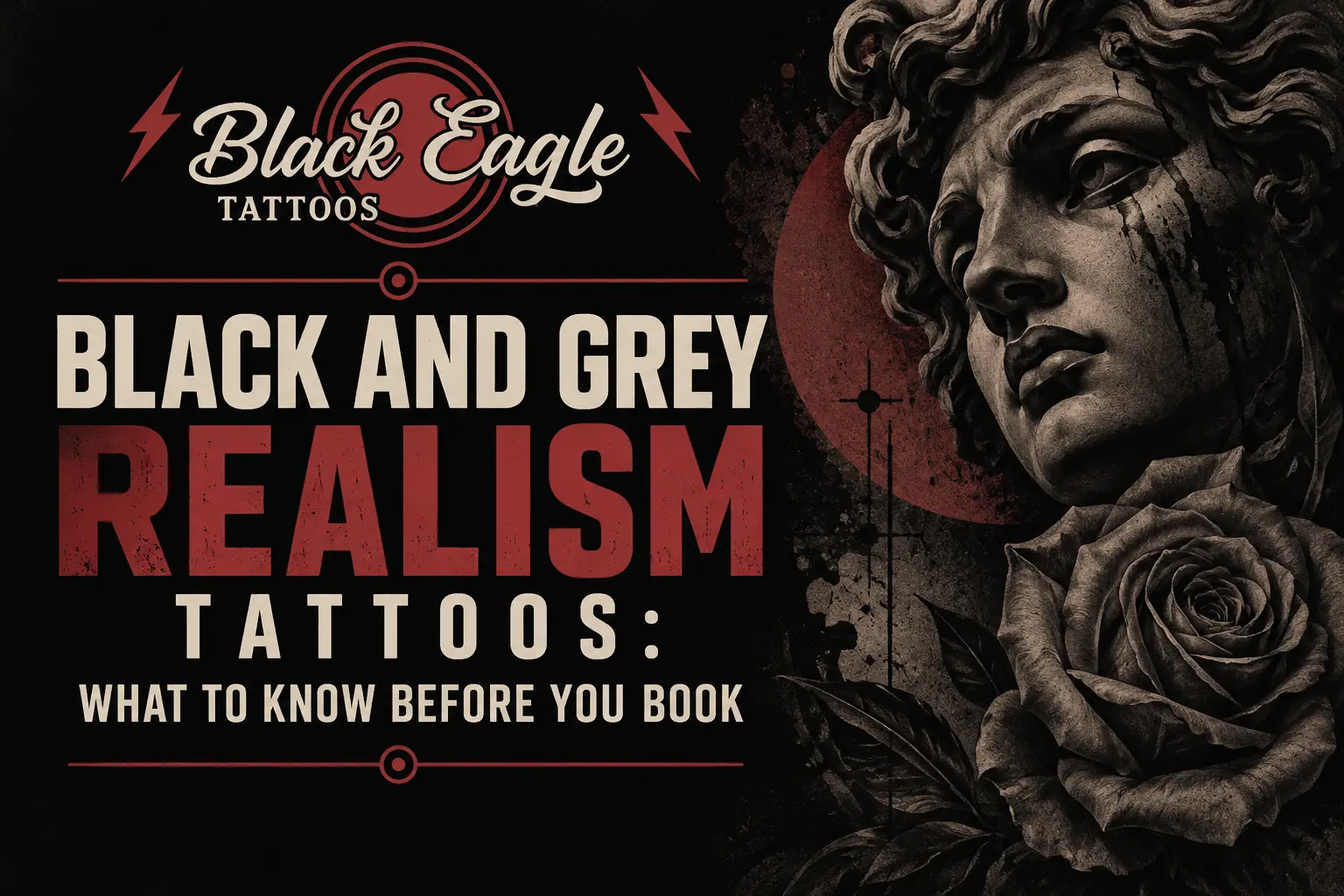
Black and Grey Realism Tattoos: What to Know Before You Book
Some tattoos look like art. Realism tattoos look like photographs. Black and grey realism is one of the most technically demanding styles in tattooing — built entirely from shades of black and grey to create depth, texture, and lifelike detail without a single line of colour.
If you’re considering a realism piece, here’s what actually goes into the style, and what to expect.
What Makes a Tattoo “Realism”?
Realism tattooing aims to recreate an image — a face, an animal, an object — as accurately as possible, the way a photograph or hyper-detailed drawing would. Instead of bold outlines and flat colour fills like traditional tattooing, realism relies on:
- Soft, blended shading instead of hard lines
- Layered greys to build depth and shadow
- Fine detail work to capture texture — skin, fur, fabric, light reflections
- Careful attention to proportion and likeness, especially for portraits
The goal isn’t a stylised version of the subject — it’s making the subject look genuinely three-dimensional on skin.
Why Black and Grey Instead of Colour?
Colour realism exists too, but black and grey is the more common (and often more timeless) choice for a few reasons:
- It ages better. Black and grey shading tends to hold its depth and contrast longer than coloured realism, which can fade or shift over the years.
- It suits portraits and detailed subjects particularly well — think animal portraits, religious imagery, or memorial pieces, where subtle shading often reads as more emotional than bold colour.
- It photographs and heals cleanly, since there’s no colour separation to worry about as the tattoo settles.
Common Black and Grey Realism Subjects
- Portraits (people, pets, memorial tributes)
- Wildlife and animals, especially detailed close-ups
- Religious and spiritual imagery
- Nature scenes — mountains, water, storms
- Objects with strong texture, like skulls, clocks, or fabric
Why Realism Requires an Experienced Artist
This is one of the least forgiving tattoo styles. Because the entire effect relies on smooth, controlled shading rather than bold lines to hide imperfections, small technical mistakes are much more visible in a realism piece than in bolder styles like traditional or blackwork.
An experienced realism artist needs:
- Strong drawing and shading fundamentals, not just tattoo technique
- A steady, controlled hand for gradual, blended greys
- A good eye for proportion, especially for portrait work
- Patience — realism pieces are usually larger and take longer per session than most other styles
What to Expect From the Process
Realism tattoos, especially portraits, usually start with a detailed consultation and reference photos. The artist needs a clear, high-quality image to work from — the better the reference, the better the final likeness. Larger realism pieces are often completed across multiple sessions, since the shading and detail work take time to build up properly.
Is Realism Right for You?
This style tends to suit people who:
- Want a specific, meaningful image recreated with accuracy (a pet, a loved one, a landscape)
- Appreciate subtle detail over bold, graphic shapes
- Are comfortable investing more time and sessions for a larger, more detailed piece
- Have a clear, high-quality reference image to work from
Start Your Realism Piece
If you have a photo or image you want brought to life as a tattoo, a consultation is the best next step. Our artists can review your reference, talk through sizing and placement, and map out what it will take to get a result that genuinely looks like your subject.
📍 TATTOO SHOP, U35 – 7/11 Collaroy Street, Collaroy, Sydney NSW 📞 0452 496 663
[Book your consultation now →]